The New Buying Journey: When Customers Never Leave the Conversation
On October 6th, 2025, OpenAI launched something that will change how customers discover local services: the ChatGPT App Store. The customer journey that used to take 60 minutes now happens in 90 seconds.
On October 6th, 2025, OpenAI launched something that will change how customers discover local services: the ChatGPT App Store.
Seven major companies (Zillow, Booking.com, Expedia, Spotify, Canva, Coursera, and Figma) went live immediately. Eleven more, including Uber, OpenTable, and Target, announced they're building apps.
All of them see the same opportunity: be where customers are making decisions.
The question isn't whether service businesses will eventually participate in this ecosystem; they will. The question today is: when customers ask AI for recommendations today, does it know you exist? The question tomorrow is: can AI book or buy your product or service?
The Zillow Moment: When ChatGPT Stopped Being a Search Engine
Zillow, yes, the real estate giant, now lives inside ChatGPT.
You can ask about homes for sale, schedule showings, and compare listings without ever visiting their website. It's not a link. It's not an integration. It's a complete experience inside the chat interface.
And it's not just Zillow, Expedia, or Target. Within months, expect to see Yelp, Angi, HomeAdvisor, Thumbtack, and every major service platform building apps of their own. They've already publicly committed to doing it.
Any company can now create its own ChatGPT app: a mini storefront that customers can find, use, and buy from right inside the chat. No browser tabs. No search results. No clicking through 10 websites.
Your customers can discover, evaluate, and hire someone, all without ever seeing a website. (Though your website matters more now than ever; where else would AI learn about you? More on that in a bit.) And as we wrote about a few weeks ago, you'll soon be selling to Agents acting on behalf or your customers.
Here's the shift that changes everything:
ChatGPT isn't just answering questions anymore. It's completing transactions.
Need a plumber? Need AC maintenance? Need a contractor for that kitchen remodel? ChatGPT can handle the entire interaction, from discovery to payment, without sending users anywhere else.
The critical insight: If you're not visible and "readable" to AI, you're invisible in this new marketplace.
The ChatGPT App Store Is Here and It's Open for Business
For years, Google has been the middleman between your business and your customers. Now, that middleman has changed.
With the release of Apps, ChatGPT just became a full-blown marketplace, and it's open 24/7.
OpenAI Press Release: https://openai.com/index/introducing-apps-in-chatgpt/
But here's what makes this fundamentally different from Google:
Traditional Search (Google):
- Customer searches "emergency plumber Atlanta"
- Google shows 10 blue links and several paid ads
- Customer opens 5 tabs, reads 5 websites
- Customer compares options
- Customer calls 2-3 businesses
- Customer makes a decision
Time invested: 60 minutes
ChatGPT (Today):
- Customer asks "I need an emergency plumber in Atlanta, someone who can come today, won't overcharge, and has great reviews"
- ChatGPT browses the web, checks availability, verifies credentials
- ChatGPT presents 2-3 pre-vetted options with reasoning
- Customer clicks one button. Done.
Time invested: 90 seconds
See the difference?
In the Google system, you had multiple chances to win the customer: your ranking, your website, your reviews, your phone skills. In the ChatGPT system, you get one chance: being the business ChatGPT chooses to recommend.
If you're not in that recommendation? You never existed.
The old customer journey gave you multiple touch points to make your case. The new journey happens so fast that customers don't even realize they just chose between you and your competitors. ChatGPT made that choice for them. And if you weren't in the top 2-3 options it presented? You might as well not exist in their market at all.
The Browser That Changes Everything
The second bombshell: ChatGPT just launched its own browser called Atlas.
That means it can now:
- Visit websites directly
- Remember context from sites you visit
- Take actions in the same way you would: clicking buttons, filling forms, booking appointments, without you having to do any of the driving
- Learn which businesses are trustworthy and which aren't
This is great for your business…unless Atlas visits your site and finds:
- Broken pages or outdated info
- Generic service descriptions
- No structured data
- Missing local signals (city names, service areas, reviews)
Atlas doesn't guess. It moves on.
Businesses with well-structured information (clear service listings, proper schema markup, and consistent reviews) become easier for Atlas to recommend confidently.
That's how "AI referrals" are already forming. Not through advertising. Through data clarity.
Here's What Makes Atlas Different From Regular Search
Google is lazy compared to AI. It crawls your website periodically, stores that information in its massive database, and references it for searches. If your site is messy today, Google has already indexed what it found on its last crawl, which might have been weeks or months ago. Changes you make don't show up in search results until the next crawl and re-indexing cycle.
Atlas evaluates in real-time. When someone asks for a recommendation, Atlas visits your website at that moment and makes an immediate decision. If your information is old / stale, unclear, incomplete, inconsistent right now, Atlas moves to sources with clearer data. There's no waiting for the next crawl cycle; it's making the call during the actual query.
And here's what makes this particularly important: Atlas builds preference patterns.
Unlike Google's index which treats each crawl somewhat independently, Atlas learns from its interactions. When it consistently finds reliable, well-structured information on one site and unclear information on another, it develops preferences based on that pattern recognition.
Think of it like this: Google is like a library catalog that gets updated periodically. Atlas is like a research assistant who goes to look up information every time they're asked a question, and remembers which sources gave them good answers before.
This means two things:
- Your site gets evaluated at the moment of query, not based on a weeks-old crawl
- Patterns matter over time - consistently clear information builds algorithmic trust, while inconsistent or unclear information creates friction that accumulates
The businesses with consistently structured, accurate information become Atlas's preferred sources. Not through SEO manipulation, but through reliability.
Translation: If you have an unclear digital presence, you might not just be losing one customer. You're being systematically filtered out.
It's like burning a bridge with a referral partner, except this referral partner handles thousands of inquiries per day in your market.
What "Machine-Readable" Actually Means
Let me translate the jargon into plain English. When experts say your business needs to be "machine-readable," here's what they mean:
Humans see your website like this:
- Nice logo ✓
- Beautiful HD video ✓
- Pretty colors ✓
- Photos of your work ✓
- "Call for a free quote!" ✓
Atlas sees your website like this:
BUSINESS NAME: [Unable to parse]
SERVICES: [Unclear]
SERVICE AREA: [Not specified]
PRICING: [No information]
CREDENTIALS: [Cannot verify]
REVIEWS: [Conflicting data]

RECOMMENDATION: Skip to competitor
Think of it like this: You show up to a networking event wearing a blank name tag. You're dressed professionally, you seem nice, but your name tag is blank.
Will people remember you? Probably not. Will they recommend you? Definitely not.
That's what your website looks like to Atlas without structured data. You're the person with the blank name tag in a room full of people wearing clear, detailed introductions.
If your site doesn't have this structure, AI sees... nothing. You might look fine to humans, but to ChatGPT, Claude, Grok, and Gemini, you're presenting incomplete information.
And incomplete information makes recommendations difficult.
Here's the interesting dynamic: Your website might be converting 3% of human visitors who find it through Google ads or referrals. From a human perspective, everything looks great. But AI can't parse the information well enough to confidently recommend you.
While you're paying $3,000/month for Google Ads to drive traffic to a site that converts humans at 3%, there's an emerging channel where customers are specifically asking AI for pre-vetted recommendations. These customers convert at significantly higher rates because they're coming to you pre-qualified and pre-sold.
The opportunity isn't replacing what's working; it's adding a channel you're currently not visible in.
How AI Changes the Referral Validation Process
If your business runs on referrals, you might be wondering why any of this matters. Here's an interesting shift that's worth understanding.
The referral process has evolved. It used to be simple: a friend recommends your company, the customer Googles your name, checks out your website and reviews, and calls you. Done.
But there's a new step happening now. Your friend recommends you on social media, and before picking up the phone, the customer asks ChatGPT: "Is [Your Business] reliable? What do people say? Are there any complaints? Who else should I consider?"
Your friend just gave you a warm introduction. But now there's a different validation step happening before the phone rings.
ChatGPT does something interesting during that validation. It pulls every review from every platform instantly, checks for licensing and credential information, looks for any complaints or concerns, and compares you to competitors in real-time. If it finds gaps in information, it suggests alternatives, not because you're not trustworthy, but because the information isn't clear enough to verify. Sounds a little scary, but in the end, we think it will lead to better customer experiences and less ability for companies to hide behind advertising. They'll have to focus on providing the best possible customer experience.
Want to nerd-out on how this all gets monetized (or doesn't)? I'd highly recommend listening to Sam Altman's take on where this is all headed in his chat with A16Z. Sitting in my seat at GTM37 I find it interesting that monetization starts on 0:37.
Here's a scenario playing out right now: Your best customer refers you to their neighbor. That neighbor, instead of just calling, asks ChatGPT about you first. ChatGPT finds 23 reviews with the last one from 8 months ago, a website that doesn't clearly list your service area, no verified credentials visible, and inconsistent business information across platforms.
Then it shows them a competitor with 94 reviews including 12 from this month, clear service descriptions with defined service areas, all credentials verified and displayed, and consistent information everywhere.
The neighbor now has two options to consider instead of one. The referral is still valuable, but it's no longer the only factor in the decision.
This isn't about referrals becoming less important. They're still the highest-quality leads you can get. But AI has added a verification layer to the process that didn't exist before. Understanding this dynamic helps you ensure that when someone validates your referral through AI, they find information that reinforces the recommendation rather than raises questions.
Zillow Is Just the Beginning
Zillow's move into ChatGPT isn't about listings; it's about purchasing directly through AI.
The moment ChatGPT users can book, schedule, and pay within the platform, the entire customer journey changes.
It's worth watching what happens when Angi launches an app to book home repairs instantly, when Yelp allows users to hire pros directly through ChatGPT, or when HomeAdvisor handles complete projects from quote to payment. These aren't hypothetical; all three companies have publicly announced they're building ChatGPT apps.
Here's the pattern worth understanding: Every major consumer platform is racing to become the "trusted layer" between customers and service providers. Google tried with Local Services Ads. Yelp tried with Request-a-Quote. Angi tried with Instant Book. They all partially worked, but they all had friction.
ChatGPT removes the friction entirely. Ask a question in natural language, get an answer, book with one click. The platform that does this best will own a significant portion of customer acquisition for local services.
And right now, that platform is ChatGPT, because 10% of the world uses it weekly.
The businesses with well-structured, AI-readable information become the default recommendations in this new ecosystem. Not through paid placement, not through SEO manipulation, but through data clarity that AI can confidently parse and present.
What Early Adoption Data Reveals
In June 2025, Ahrefs published data that stopped marketers in their tracks: AI search visitors were converting at 23 times the rate of traditional organic search visitors. Just 0.5% of their traffic drove 12.1% of all signups.
A larger study by Semrush confirmed the pattern. AI search visitors are 4.4 times more valuable than traditional organic search, measured by conversion rates.
Why? By the time someone visits your site from ChatGPT, they've already compared options and learned about your value proposition. AI responses feel like personal recommendations, not search results.
Here's what that means in dollars you can bank:
If you're doing $500K/year: That's $75K-$100K in potential revenue flowing through AI by end of 2026. At 40% margins, that's $30K-$40K in profit.
If you're doing $2M/year: You're looking at $300K-$400K in play.
But here's the catch: AI recommends 2-3 businesses per query. If you're #4, you don't exist. That revenue doesn't disappear; it goes to the competitors AI does recommend.
The businesses optimizing for AI now will capture majority exposure as this channel solidifies. The conversion rates are too high to ignore, and the window to establish visibility is right now.
What Service Businesses Should Do
You're either in AI's recommendation set or you're not. There's no middle ground. No page 2. No "we're kind of visible."
ChatGPT recommends 2-3 businesses. If you're not in those recommendations, as Ricky Bobby would say "If you ain't first, you're last".
Here's your action plan:
1. Find Out What ChatGPT Knows About You
Open ChatGPT and ask these exact questions:
- "Who are the top-rated [your service] providers in [your city]?"
- "I need [your service] in [your city]. Who should I call?"
- "Tell me about [Your Business Name]. Are they reliable?"
If your name doesn't appear in the first two queries, you're invisible. If the third query can't find accurate information, you have a visibility problem.
Do this once a week. Track whether you're appearing. Your competitors are.
When you do this test, pay attention to what position you're in (1st, 2nd, 3rd recommendation), what ChatGPT says about you and whether it's accurate, who else it recommends, and whether it recommends you at all. This is your baseline. Every optimization you make should move these metrics in the right direction.
2. Make Your Website Machine-Readable
Update your site to include what you do (specific services, not vague descriptions), where you serve (specific cities/zip codes), how to contact you (consistent everywhere), why you're qualified (licenses, certifications, years in business), and proof you're trustworthy (real reviews, real projects).
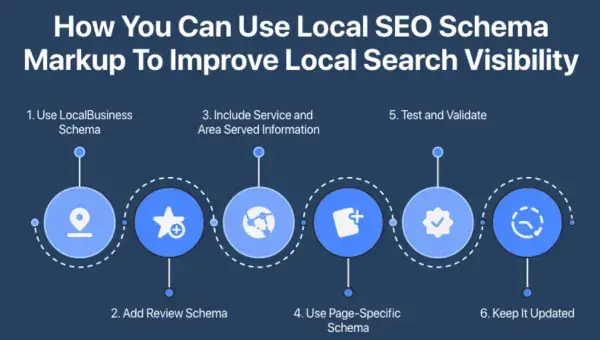
From a technical standpoint, you need schema markup (LocalBusiness, Service, Review structured data), fast-loading pages, mobile-optimized design, FAQ sections with real customer questions, and clear service descriptions with pricing transparency.
This helps AI understand what you do, where you do it, and who you serve.
If you're thinking "I don't know how to do schema markup," you have a few options. You can hire someone who does, learn it yourself, or use a platform that handles it automatically. What matters is getting it done.
Let me be specific about schema markup for a second, because this is where most businesses struggle. Schema markup is code that helps search engines and AI understand your website. It's like giving your website a nutrition label; instead of making AI guess what's in your business, you tell it explicitly.
For a local service business, you need at least LocalBusiness schema (your business type, name, address, phone), Service schema (what services you offer, service areas), Review schema (your ratings and reviews in a structured format), and FAQPage schema (common questions and answers).
Most website builders (Wix, Squarespace, WordPress with plugins) can add basic schema automatically. But "basic" often isn't enough for AI to confidently recommend you over competitors who have comprehensive schema.
This is one of those things where doing it 80% right means being invisible, and doing it 100% right means being the default recommendation.
3. Build Digital Authority
AI systems use signals to verify trust. They look for your Google Business Profile (complete, updated, active), 4.5+ star average reviews with recent reviews, industry citations (BBB, Angi, industry associations), professional credentials (licenses, certifications, insurance), updated project photos and testimonials, and content demonstrating expertise (FAQs, how-to guides).
AI reads these as trust indicators. Without them, you look risky, even if your work is flawless.
Here's the thing about trust signals: they compound. When ChatGPT sees 127 five-star reviews, 12 years in business, proper licensing, and 200+ completed projects, you stop being an option. You become THE option. This was always true, but AI weights reviews more heavily than SEO of the past.
Your competitor with 12 reviews from 2022 and an outdated website? Not even considered.
Think of it like this: AI isn't just checking one thing. It's checking everything and assigning a "trust score" in milliseconds. Each positive signal raises that score. Each negative signal (or missing signal) lowers it.
The businesses with the highest trust scores get recommended. Everyone else gets filtered out.
So this isn't about doing one thing really well. It's about doing 10 things pretty well, so that when AI scans your digital footprint, it sees consistent evidence that you're the real deal.
4. Monitor Your AI Visibility Monthly
Just like you'd check Google rankings, start tracking your AI visibility.
Set a recurring calendar reminder for the first Monday of every month: "Check AI Visibility." It takes 15 minutes. Ask ChatGPT who it recommends in your category, check if Claude and Gemini cite your business, search on Perplexity.ai, Google your services and check AI Overview, document what AI says with screenshots, and note any incorrect information so you can fix it.
If you don't measure this, you can't improve it.
Here's what you'll notice over time: which competitors are gaining AI visibility, whether your optimizations are working, what information AI is finding about you, and where you're losing ground.
These aren't vanity metrics. This is competitive intelligence for the channel that will drive 20% of your leads within 18 months.
Our Predictions for the Next 12 Months
Here's what we're seeing in the market, and why understanding these trends matters for local service businesses.
The Apple-OpenAI Dynamic
Apple has been unusually transparent about their AI challenges. They've publicly acknowledged they're behind in AI development and have indicated they're exploring partnerships with leading AI labs. OpenAI is the most likely candidate.
If that partnership materializes, here's what changes: Atlas (ChatGPT's browser) could replace Google as the default search engine on iPhones. That would instantly put ChatGPT in the hands of every iPhone user worldwide (roughly 1.5 billion people).
This isn't speculation about whether AI search matters. This is about distribution at a scale that changes customer behavior overnight.
What This Means for Mobile-First Customers
Most local service searches already happen on mobile. When someone's sink is leaking or they need emergency AC repair, they're pulling out their phone, not opening their laptop. If that phone defaults to ChatGPT instead of Google, the customer journey changes fundamentally.
They won't see 10 blue links. They'll see 2-3 pre-vetted recommendations. And if your business information isn't structured for AI to parse confidently, you won't be one of them.
The Timeline We're Watching
Q4 2025 (Current): Early adopters are optimizing for AI visibility while most businesses remain unaware. AI-driven transactions are still less than 1% of the market but growing quickly. The interesting part: being visible in ChatGPT's recommendation set is relatively straightforward right now because competition is light.
Q1-Q2 2026: We expect to see major platform integrations announced. The Apple partnership (if it happens) would likely be announced in this window. AI-driven discovery could reach 5-10% of transactions. Business owners will start noticing they're losing leads without understanding where they went. Competition for AI visibility will increase as awareness spreads.
Q3-Q4 2026: AI visibility becomes standard practice rather than competitive advantage. Businesses that waited will scramble to catch up, but early movers will have built momentum that's difficult to overcome. AI-driven discovery could reach 15-20% of transactions.
Why Timing Creates Advantage
AI systems learn patterns over time. They develop preferences based on consistency and reliability of information. A business that's been AI-visible for 12 months has established a pattern that AI trusts. A business that just started optimizing last week is an unknown.
It's similar to how compound interest works: the earlier you start, the more momentum builds. Not because early adopters are smarter, but because they gave the system more time to learn that they're trustworthy.
This isn't about creating artificial urgency. It's about understanding that when major distribution shifts happen (like a potential iPhone default search change), the businesses that are already visible benefit immediately. The businesses that aren't visible need to build that foundation from scratch while trying to compete with established players.
The opportunity right now is that you can establish AI visibility before it becomes crowded. Not because you'll "miss out" if you don't, but because building visibility takes time, and time invested early compounds.
The New Game: Be Discoverable Where AI Shops
Your next customer might not "visit your website" in the traditional sense. They'll interact with your business through an AI interface. But, your website now serves a dual purpose: to convert human visitors and to be understood by AI systems that recommend you.
The question isn't just "How do I rank on Google?" anymore.
It's also: "When someone asks ChatGPT for what I do, does it know I exist?"
The businesses that win in the next decade won't necessarily be the best at what they do. They'll be the ones that customers can actually find. And increasingly, customers are finding businesses through AI, not search engines.
The Bottom Line
ChatGPT apps and the Atlas browser mark the start of a massive shift, one where customers don't just search through AI, they buy through it.
For local service businesses, this isn't about keeping up with tech trends. It's about being visible where the next generation of customers actually makes decisions.
Zillow saw this coming; that's why they moved first.
Because in 2025 and beyond, your most powerful referral partner isn't human.
It's artificial. And it's already making introductions.
Where to Start
If you've made it this far, you understand how AI search is changing customer discovery. Here's how to move forward:
Start with visibility: The first step is understanding where you currently stand. What does ChatGPT say when someone asks about services like yours in your area? Run the tests we outlined earlier, or use our free audit tool to get a comprehensive view of your AI visibility across multiple platforms.
DIY or delegate: Some businesses prefer to handle optimization in-house. If you have technical resources and content creation capacity, the framework in this article gives you everything you need. Others prefer to focus on running their business while someone else handles the optimization. Both approaches work; it depends on your bandwidth and priorities.
How we can help: We work with service businesses that want to establish AI visibility but don't have the time or technical expertise to implement it themselves. Here's what that looks like:
- Free Digital Presence Audit: See what AI systems currently know about your business and where the gaps are. Takes about 2 minutes to request. Get your audit
- AI-Ready Websites: We build sites with proper schema markup, structured data, and fast performance built in from day one. Designed to be understood by both humans and AI systems. Learn more
- Ongoing Content Marketing: Monthly interviews where we capture your expertise and turn it into AI-readable content that keeps you visible. We handle the writing, optimization, and distribution. See how it works
The businesses establishing AI visibility now are building an advantage that compounds over time. Not because of artificial scarcity, but because AI systems learn from consistency and reward businesses they've learned to trust.
Whether you implement this yourself or work with us, the important thing is understanding that customer discovery is evolving. The businesses that adapt to how customers actually search will be the ones customers actually find.