The Partnership Playbook: How to Get Other Businesses to Deliver Your Next Customers
The most successful service business I ever encountered was run by a guy who barely advertised. Jim had 47 other business owners actively sending him customers. His secret? He understood that every business you interact with is a potential multiplication machine.
The most successful service business I ever encountered was run by a guy who barely advertised.
Jim owned a commercial cleaning company in Southern California. Nothing fancy. But he had 47 other business owners actively sending him customers. Not occasionally. Consistently.
His secret? He understood something most service businesses miss: Every business you interact with is a potential multiplication machine for your growth. That accountant who does your books sees 200 other business owners monthly. That commercial real estate agent knows every property manager in town. That equipment supplier talks to all your competitors' customers.
Jim didn't just service these businesses - he turned them into active partners. And his phone never stopped ringing.
The Partnership Principle Most Service Businesses Never Learn
Every business school teaches the same truth, but somehow it never makes it to Main Street: You can't outspend your competition, but you can out-partner them. Your ecosystem creates a moat your competition can't easily replicate or beat.
As Bob Moore, who wrote the book on this strategy called Ecosystem-Led Growth, defines it perfectly:
"A partner is an outside company, organization, or person with whom you 'win together'. Typically these wins are achieved because you have shared customers, markets, and/or goals."
Partners have "some direct economic incentive to help you win" through:
- Generating new business
- Increasing loyalty of existing customers
- Earning commissions
- Building relationship capital
The Four Types of Partners
To cut through the jargon, think about partnerships in terms of four types. These types generally revolve around how each collects cash from customers, and where in the marketing funnel they help you.
1. Referral Partners
These create demand or awareness for your business. The real estate agent recommending your home inspection service. The insurance adjuster who suggests your restoration company. These work great for service businesses.
Commercially, these partners send business your way, and get a commission or a reciprocal referral in return. NPI and BNI are two groups that actively encourage this type of partnership.
But there's a new type of referral partner emerging. And it's perhaps your best referral partner. More on that below.
2. Technology Partners
In big tech, these fill product gaps. For service businesses, it's different. This is about having the capabilities your customers expect.
One example: A specialty cleaning business has special processes that allow it to clean high-end upholstery that competitors won't touch. Rather than missing out on the opportunity altogether, they partner with competitors and allow them to offer the service to their customers under their own brand in exchange for a large chunk of the revenue.
In the software space we call this "white labeling." You get to say yes to your customer, using your brand, for capabilities you don't really have - and in exchange, I get business I wouldn't have seen otherwise.
3. Channel Partners
Channel partners mainly exist to fulfill orders or deliver services once they're sold. This generally happens for:
- Geography - local language or time zones may make it difficult for the company to sell to a different area
- Legal or Customary - some cultures prefer to do business in specific ways or with an insider
While it may seem like channel partners aren't a great fit for service businesses, give it extra thought. Large metropolitan areas often have a diverse mix of cultures, and it may help you to work with another business that could open a market for you.
4. Marketplaces
Marketplaces are matchmakers. They match a buyer with a seller and take a percentage of the profit as a fee.
HomeAdvisor. Thumbtack. Angie's List. You know them. But here's what you might not realize - these ARE partners. They have shared customers with you. They win when you win (and take their cut). The question isn't whether to use them, but how to maximize your return while building direct relationships.
The Mindshare Battle No One Talks About
Sometimes you're not the only partner a company works with. Sometimes you even have a partner that works with your competitors.
Let me tell you about winning in a crowded partnership ecosystem.
Years ago, I ran distribution for a GPS fleet tracking product sold through Sprint's B2B sales team. Here's the problem: Those reps had 5 similar products they could sell. My competitors had the same features, similar pricing, same commission structure...and most dangerously, knew the same players at Sprint I did.
So how did we win?
Mindshare.
When a sales rep called with a question, I answered every call within 2 rings, no matter what time. I knew each rep's name, their kids' names, their sales goals, how they got paid, and the questions their customers would ask before they were asked.
I sent them case studies showing exactly how they'd make MORE money selling my product. I made myself so easy to work with that when a customer asked about fleet tracking, my product name came out of their mouth first.
That's mindshare - being top of mind when decision time comes.
Now imagine having that same mindshare challenge, except your "partner" isn't a human sales rep. It's ChatGPT. Or Google Gemini. Or Grok.
How do you win mindshare with an AI that knows every plumber in your city?
The Referral Partner That Never Sleeps
Here's the shift that changes everything:
ChatGPT is the world's most powerful referral partner.
Think about it:
- Talks to 100+ million people daily who use it to find their next vendor
- Never forgets a business (if it knows about it)
- Available 24/7/365
- No commission required
- No relationship maintenance needed
- No coffee meetings or golf games
- Never plays favorites (unless you give it a reason to)
But here's the catch - AI can only recommend businesses it knows and trusts.
When someone asks ChatGPT for a reliable HVAC company in your area, it's making a referral decision in milliseconds. Just like that Sprint sales rep choosing which GPS product to pitch.
The difference? You can't take ChatGPT to lunch. You can't send it a holiday card. You can't rely on personal relationships.
You have to earn AI's trust through digital signals. Put another way, AI doesn't trust a company that isn't online.
Partner Marketing in the AI Age
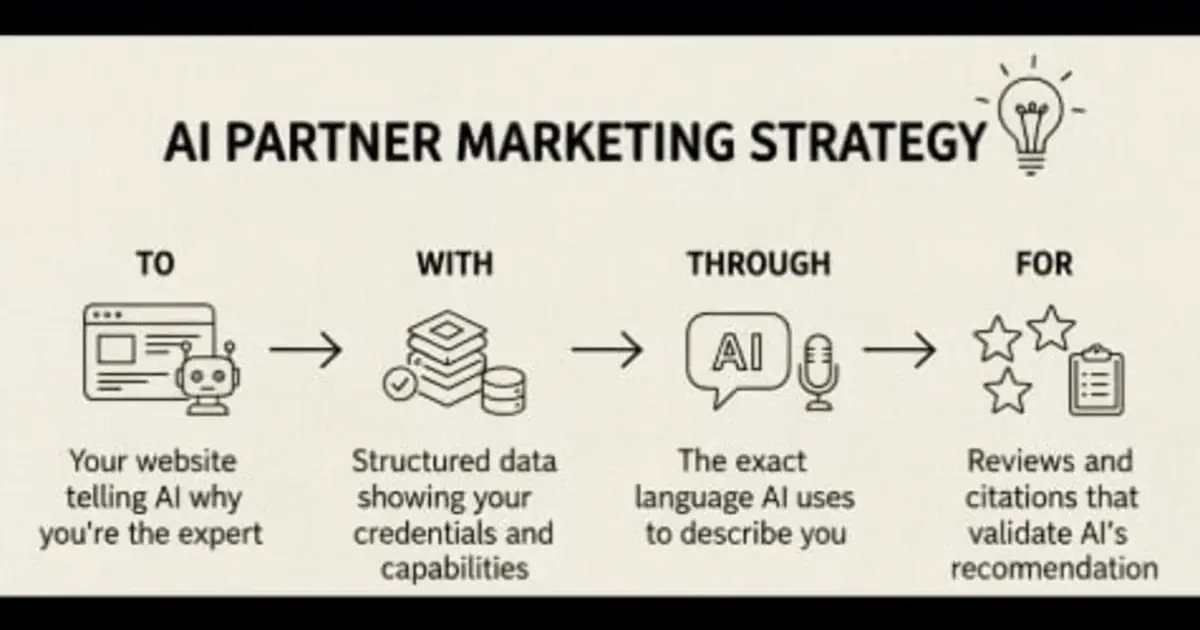
Traditional partner marketing has four directions. Every partnership pro knows these by heart:
Traditional Partner Marketing:
- TO partners: Why they should work with you
- WITH partners: Why customers should buy from both of you
- THROUGH partners: Content for them to share about you
- FOR partners: Content you create about them
Here's the important bit. While AI has tremendous reach, it's extraordinarily lazy. Its goal is to find an answer for its user in the most efficient, least resource-consuming way. This means you have to make things incredibly simple for AI to find, and get to know, like, and trust you.
This isn't just theory. This is how you become ChatGPT's favorite plumber when it knows 12 others.
The Mindshare Multiplier
Remember my Sprint story? The secret wasn't just being available - it was making it impossibly easy for reps to choose me over competitors.
With AI partners, it's the same game with different rules:
| Traditional Approach | AI-Optimized Approach |
|---|---|
| Answering phone calls quickly | Fast-loading, mobile-optimized websites |
| Sending commission checks | Clear, structured information AI can read |
| Taking reps to dinner | Consistent citations across the web |
| Personal relationships | Digital authority signals |
Getting Started
All of this can feel overwhelming. Like there's too much to learn and not enough time. The truth is, the clock is ticking. But you don't have to know everything yourself.
Start with these three steps:
-
Audit your current partnerships - Who's already sending you business? How can you formalize and expand those relationships?
-
Identify partnership gaps - What businesses serve your ideal customers before or after you do? Those are your potential partners.
-
Optimize for AI - Make sure your digital presence is complete, consistent, and crawlable. This is your AI partnership foundation.
The businesses that master both human and AI partnerships will dominate their markets. The ones that ignore either will struggle to keep up.
Your phone is about to start ringing. The question is whether it'll be ringing because of partnerships you built, or sitting silent while your competitors' phones ring off the hook.